
Recently, my friend musician and composer Stan Stewart posted on his blog about how he constructed his virtual “band” for his current project. Stan alleged that I’m kind of good at this whole virtual band thing so I thought maybe I follow up his excellent observations on the topic with some humble offerings of my own.
Why a Virtual Band?
Composing sure has changed over the last few decades. Used to be, you’d write notes on a page, hand the manuscript to the musicians, and they would play the music. If you were good at an instrument you might join in.
Composing still works like like that but more often then not we also have to produce a “mock up”, in other words, an audio realization that allows a client to hear what the music will sound like when it’s finally recorded by the musicians.
And then you have people like me, and there are a lot of us. Folks like me are composer, musician, producer, recording engineer, and publicist. We skip the “mock ups”, go straight to the finished product, and we do it mostly by ourselves.
To make this happen, many of us use virtual instruments, highly playable recorded versions of everything from violins to pianos to rusty trash cans hit with pool noodles. There are so many options out there that one can quickly descend into option anxiety and get nothing done. That’s where the “virtual band” comes in.
What is a Virtual Band?
When I’m composing I like to limit my options. By doing so it forces me to solve my compositional problems with the tools in front of me instead of spending my entire session looking for the perfect fog horn (free tip: an open C played on a viola sul ponticello with some reverb makes a passable fog horn).
My most recent album, ‘The Fisher King’ was probably the first where I worked to not only set limits and constraints on my sound pallet but also design those constraints around a virtual musical ensemble. To accomplish that I decided I wanted to create a virtual ensemble that met two, specific, criteria:
- It could exist in the real world. In other words I could assemble a group of real musicians to play the music.
- I could participate in the ensemble. In my case either as the pianist or synth player. Probably the latter as that’s my performance background.
So I set to creating the ensemble. I’d be lying if I said I created the perfect ensemble right off the bat. It took weeks of iterations and composing to get to the grouping I wanted for the project. In the process I had two pieces almost complete before I decided what was going to work for the rest.
Once it was settled though, I had a workable group I felt I could do almost anything with:
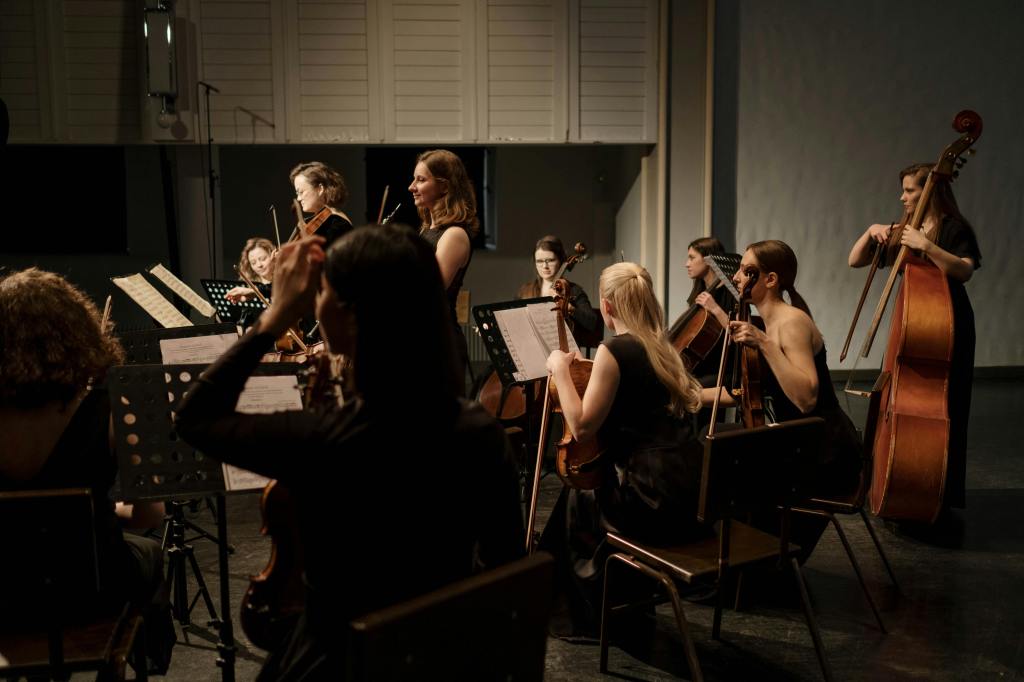
- A string quintet: two violins, viola, cello, and bass
- Piano
- Assorted Percussion, probably enough of an assortment to require two players.
- Synthesizers and samplers. This one is tricky because it opens so many options but essentially I envisioned what could be managed by a single player without sequencing or automation.
- I brought in a “guest” clarinet player on the song “A Fool’s Errand” which ironically didn’t make it on the album. I guess he was visiting friends?
- The last piece on Fisher King really wanted a full orchestra for the finale and who am I not to oblige? I asked the rest of the virtual team and they were cool with it 😉
In Practice
With ensemble gathered I knew what I had to work with and was able to constrain myself to that pallet. It got challenging at times when I tried to achieve something I was hearing in my head but the available players weren’t going to fit that specific bill. Instead of cheating, I just kept working the problem with the existing constraints. The interesting thing is the eventual solution was often much better than the original idea I had in my head.
By the time I was done I realized that this approach came with some very satisfying benefits:
- The whole album sounded consistent across all the pieces in the same way that a rock band will sound pretty consistent across the length of an album.
- The constrained pallet really forced me to come up with creative solutions to compositional problems that I probably would not have arrived at had I allowed myself to reach for easy options.
- Writing for the ensemble made me feel more like I was writing for other people. I wanted their parts to be interesting and I even found myself worrying if any of the players would find their part boring.
- I could, if the opportunity arose, adapt this music to an actual, human, ensemble.
I’m at it again now working on a new project. I spent a lot of time over the last few weeks goofing with a lot of sample instruments and weird textures but I’m not feeling it. In the last few days I’ve realized that this virtual ensemble approach works really well for me and I do believe I’m going to try it again. I’m still working out what the ensemble will be but I think I’m going to be calling back many of the same folks who “played” on Fisher King. They were a fun bunch 🙂
Peace.
 John M Davis
Leave a comment